Comeback / Luxury / 2000s
Burberry's Recovery From Overexposure
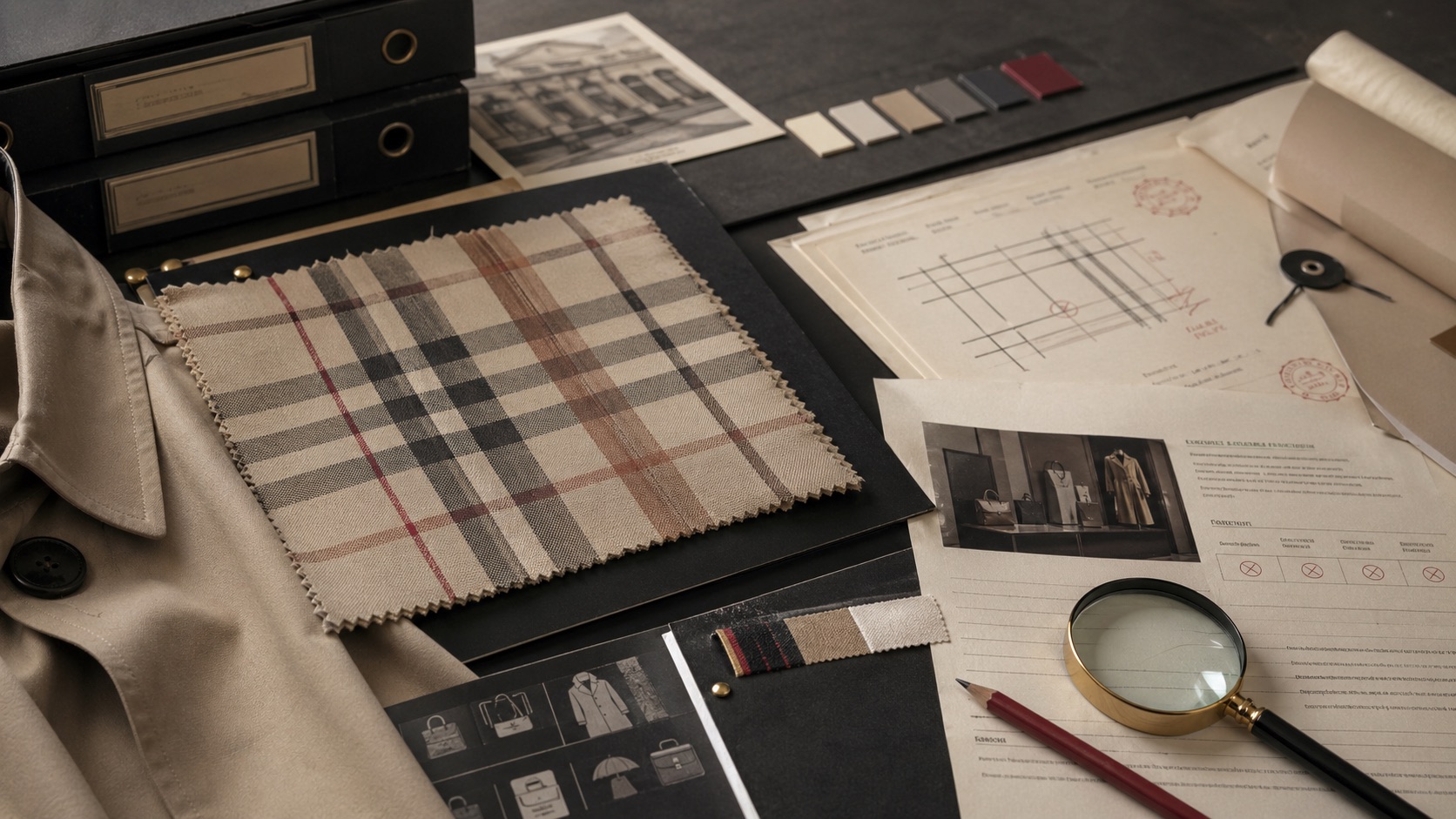
The comeback required more than a new campaign. It required distribution restraint, symbol control, and a clearer boundary around the check.
Key Takeaways
- The check was not weak because it lacked recognition. It was weak because recognition had become too uncontrolled.
- Burberry's recovery required centralizing design authority and reducing the noise created by fragmented licensing.
- The trench coat became a stronger anchor than the exposed check because it restored product, heritage, and luxury discipline.
- The operating lesson is that luxury symbols need governance, scarcity, and context, not only awareness.
The Decision Context
Burberry entered the 2000s with one of the most recognizable visual assets in luxury: the check. Recognition was not the problem. Control was. The pattern had traveled across categories, licensees, copies, and cultural contexts until a heritage signal began to carry associations the company did not want.
This is the unusual danger of a strong symbol. When it is too available, the same recognizability that once created value can begin to dilute the brand. Burberry did not need the market to learn the check. It needed the market to stop seeing the check everywhere.
What Broke
The public story of Burberry's overexposure is often told through the language of image decline, but the operating problem sat deeper than image. Harvard Business Review's account by Angela Ahrendts describes a business that had lost focus through global expansion, with 23 licensees doing different things around the world. Ubiquity was robbing the brand of luster.
The Guardian's 2013 profile of Ahrendts described the check's association with a downmarket image and noted that the brand had to buy back licenses that allowed the check to appear across too many products. Whether the cultural shorthand was fair or not, the strategic problem was clear: a luxury signal had become too easy to access and too hard to control.
The Recovery Move
The recovery was not simply a better campaign. It was a governance reset. Ahrendts and Christopher Bailey recentralized creative control, pushed the company back toward its historical core, and made the trench coat a central product and storytelling anchor. The point was not to erase the check. It was to put heritage back under discipline.
This matters because a luxury comeback rarely begins with more visibility. It begins by deciding what should become less available. The company had to narrow the places where the symbol appeared, control how the brand showed up globally, and make the product system feel coherent again.
The Symbol Lesson
The Burberry case is a symbol-governance case. It shows that brand assets do not only need recognition. They need rules. A pattern, color, shape, character, or product form can become so recognizable that leadership starts treating it as endlessly extendable. That is where dilution begins.
A luxury symbol carries value partly because it appears in the right places, at the right frequency, and with the right product support underneath it. When the same signal appears across too many low-control contexts, the brand may still be famous, but the fame becomes less useful.
The Operating Pattern
The operating pattern is subtraction before amplification. Before a brand tries to make a damaged symbol desirable again, it must reduce misuse, stop weak extensions, and clarify who controls the system. Only then can storytelling rebuild value.
Burberry's later strategy emphasized core heritage, retail-led execution, digital communication, and the trench coat as an icon. The lesson for other brands is not to copy the trench-coat strategy. The lesson is to identify the protected asset, decide where it may appear, and make every use of it reinforce the desired meaning.
Comparable Cases
Sources
- Harvard Business Review, Burberry's CEO on Turning an Aging British Icon into a Global Luxury Brand, January 2013
- The Guardian, How an American woman rescued Burberry, a classic British label, June 16, 2013
- Burberry plc, Annual Report 2010/11
- EconBiz record, Burberry's CEO on turning an aging British icon into a global luxury brand
- Wikimedia Commons, Burberry nova check

Frequently Asked Questions
What type of case is Burberry?
Burberry is currently filed under Comeback.
What does this file cover?
It records the decision pattern, consequence, and decision lesson for the case.
Why does this case matter?
It shows how a brand decision can change recognition, trust, or control beyond the visible design surface.
Does the article contain a commercial CTA?
No. Brand Archive article pages do not carry in-article commercial calls to action.