Failure / Beverage / 1985
New Coke and the Error of Replacing Memory
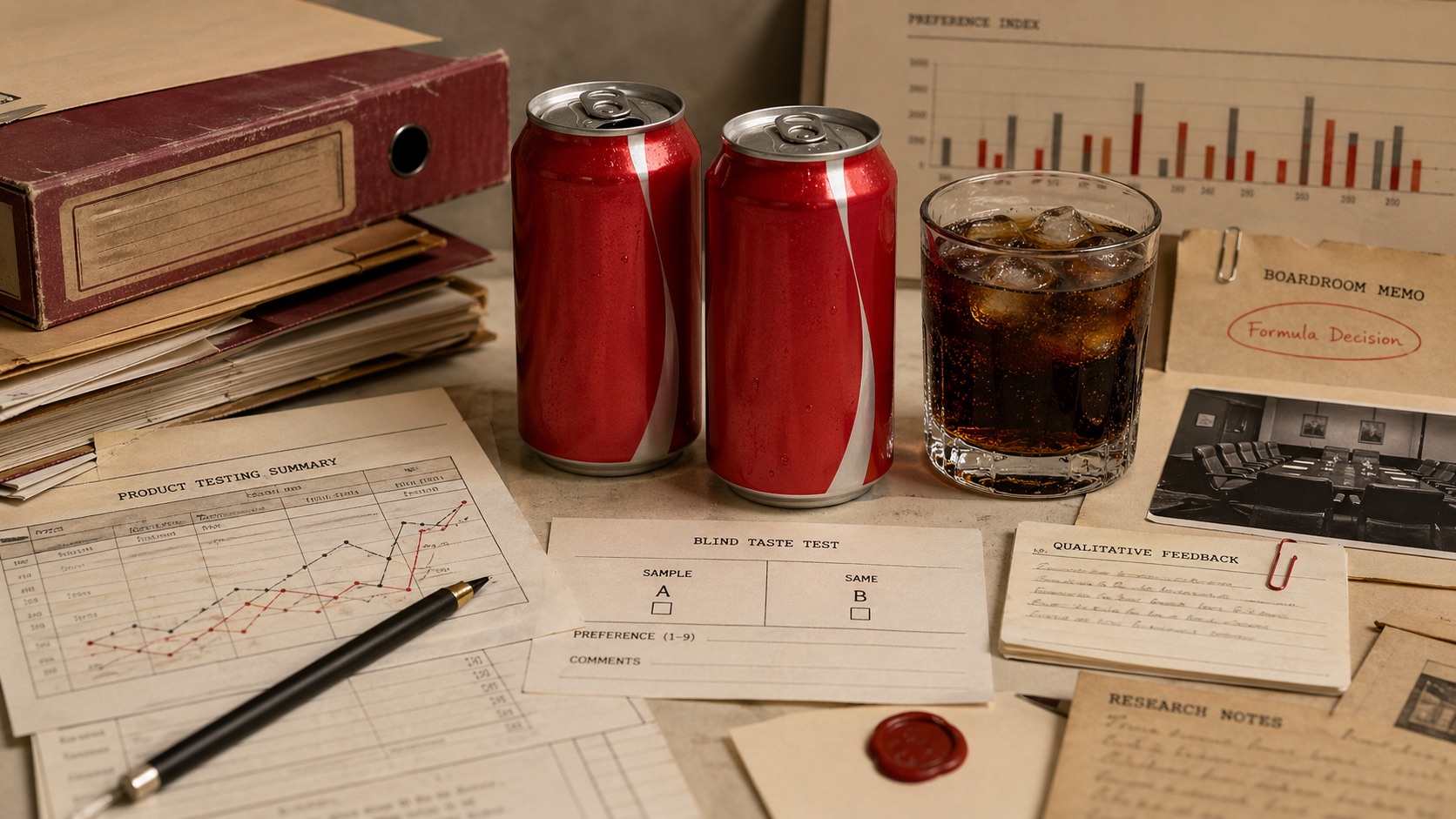
The product test measured preference. The market response revealed ownership, ritual, and identity sitting underneath the formula decision.
Key Takeaways
- The taste-test evidence answered a narrow product question, not the larger brand-ownership question.
- The launch replaced the original formula instead of treating the new formula as a managed addition.
- The backlash showed that customers can feel ownership over a brand asset even when the company owns the trademark.
- The return of Coca-Cola Classic turned the failure into a permanent lesson about memory, ritual, and control.
The Decision
On April 23, 1985, The Coca-Cola Company announced that it was changing the formula of its flagship cola in the United States. The company introduced a reformulated product that became known publicly as New Coke. The move was meant to respond to competitive pressure in the cola category, especially Pepsi's momentum and the long-running taste-test narrative around sweeter cola preference.
The decision was not made without evidence. Coca-Cola's own history of the event says the new formula had been preferred in taste tests of nearly 200,000 consumers. The mistake was not that the company ignored research. The mistake was that the research answered the wrong strategic question. It measured which liquid people preferred in a controlled test. It did not measure what would happen when the familiar product was removed from public life.
What The Research Missed
A blind taste test isolates flavor. A brand decision does not. Coca-Cola was not only a beverage formula in 1985. It was habit, national memory, advertising language, refrigerator ritual, family routine, and a piece of American commercial identity. Those meanings do not appear clearly when people are asked to choose a sip in a test environment.
The public reaction revealed a distinction that still matters for brand operators: preference is not the same as permission. A customer may prefer a sweeter sample and still reject the company's right to remove the original. In the New Coke case, the product was changed, but the public experienced the move as a break in continuity.
What Broke
The reaction was fast and emotional. Coca-Cola's own account describes consumer complaints, public protest, hoarding of the old product, and calls into the company. HISTORY reports that the company received thousands of calls a day and tens of thousands of complaint letters. The intensity made clear that the decision had moved beyond taste.
The strategic issue was control. By replacing the original formula, Coca-Cola made the decision feel final. Customers were not being invited to try a new product. They were being told that a shared ritual had been changed for them. That is why the case still has force: the company owned the recipe, but the public felt it owned the memory.
The Reversal
On July 11, 1985, Coca-Cola announced the return of the original formula as Coca-Cola Classic. The company's own history frames the return as the cap on 79 days that transformed the company and the soft-drink industry. The reversal did not make New Coke disappear immediately, but it restored the public's access to the product memory that had been removed.
The return also changed the meaning of the failure. New Coke became a permanent reference case because the company survived the mistake and, in some ways, strengthened the emotional salience of the original. But that outcome does not make the decision strategically sound. It shows how powerful the underlying asset was.
The Decision Lesson
The lesson is not that brands can never change products. The lesson is that product changes need to identify which layer of the brand they are touching. A formula can be chemistry, but it can also be continuity. When continuity is the asset, replacement behaves differently from extension.
A better decision process would have separated product preference, market share pressure, category positioning, customer memory, and transition design. The most dangerous question was not whether the new formula tasted better. It was whether the company had the right to make the old experience unavailable.
The Operating Pattern
New Coke is the operating pattern for research overconfidence. The more confident the quantitative answer looks, the more important it becomes to ask what the test excludes. If the test strips away brand name, memory, context, and ownership, it can produce a clear answer to a partial question.
Before replacing a legacy asset, leadership needs a protected-memory map. That map asks what customers would feel had been taken away if the asset disappeared. If the answer is ritual, identity, or continuity, the decision cannot be treated as a product optimization alone.
Comparable Cases
Sources
- The Coca-Cola Company, New Coke: The Most Memorable Marketing Blunder Ever?
- The Coca-Cola Company, Veteran Employees Remember Infamous 1985 Launch of New Coke, April 23, 2015
- HISTORY, New Coke debuts, one of the biggest product flops in history, updated May 27, 2025
- HISTORY, Why Coca-Cola's New Coke Flopped, updated May 27, 2025
- Encyclopaedia Britannica, New Coke, updated February 23, 2026
- Snopes, Was the New Coke Fiasco Just a Clever Marketing Ploy?
- Wikimedia Commons, New Coke can

Frequently Asked Questions
What type of case is New Coke?
New Coke is currently filed under Failure.
What does this file cover?
It records the decision pattern, consequence, and decision lesson for the case.
Why does this case matter?
It shows how a brand decision can change recognition, trust, or control beyond the visible design surface.
Does the article contain a commercial CTA?
No. Brand Archive article pages do not carry in-article commercial calls to action.